

THE SOUTH POLE TELESCOPE DELIVERS COSMOLOGICAL RESULTS FROM ITS DEEP FIELD: AN UNPRECEDENTED TEST OF THE STANDARD MODEL
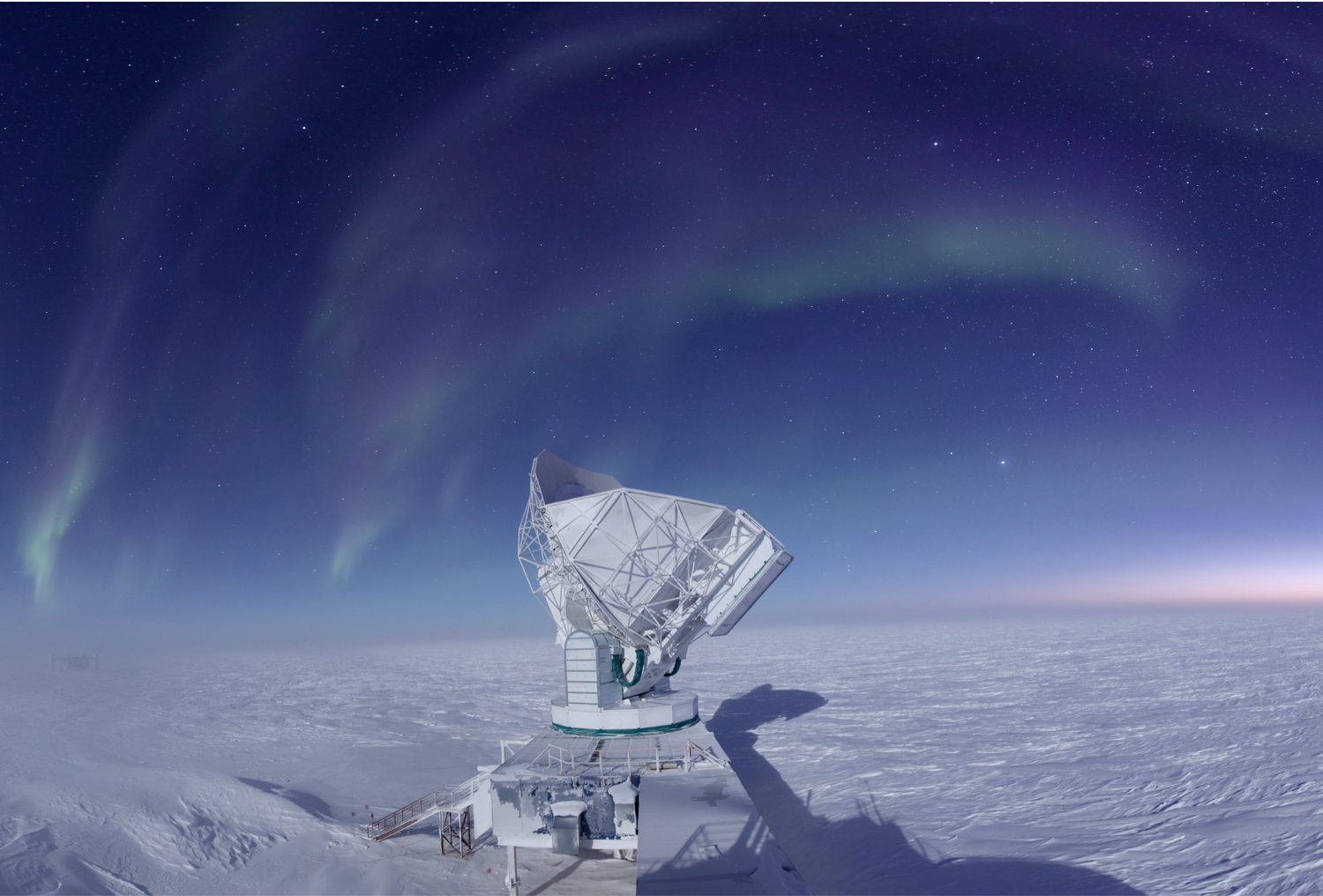 The South Pole Telescope
Credit: Jason Gallicchio
The SPT collaboration has just published a new study based on the first two years of observations from the SPT-3G receiver, with the analysis led by researchers from the Institut d’Astrophysique de Paris (IAP). These results, recently published in Physical Review D, provide the most precise measurements to date of small-scale polarization of the cosmic microwave background. While they confirm the overall robustness of the Big Bang model, they also reinforce the persistent tensions in the Universe’s expansion rate and raise new questions about the nature of dark energy.
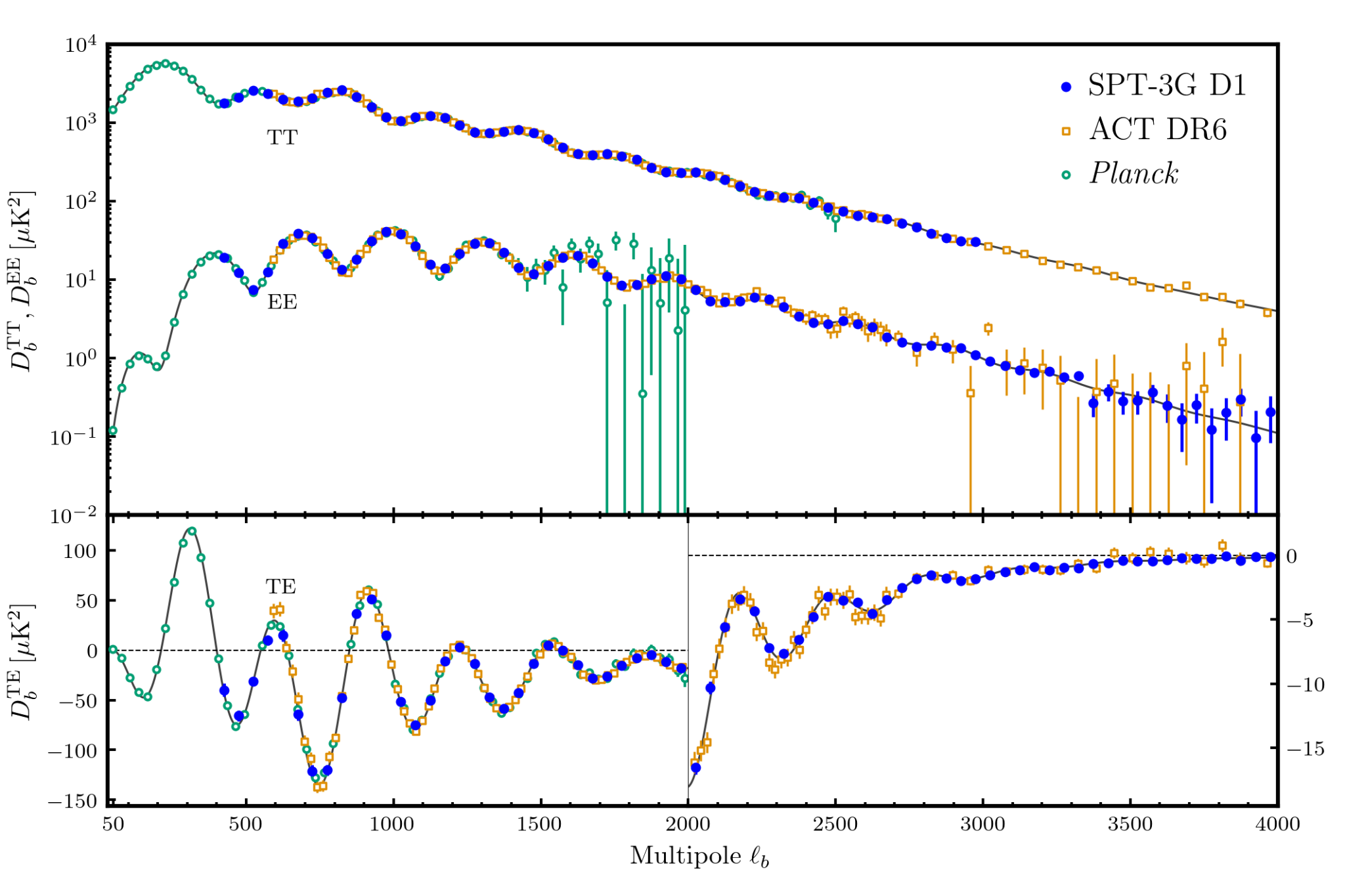 Comparison of the precision of CMB observations from Planck, ACT (Atacama Cosmology Telescope) and SPT-3G. The blue points (SPT-3G D1) show the most constraining measurements to date of the CMB power spectra in polarization at small angular scales.
Source: Camphuis et al., 2025
A technological and scientific milestone
The cosmic microwave background (CMB) is the oldest image of the Universe, emitted 380,000 years after the Big Bang. By analyzing the tiny temperature variations and the polarization of this fossil light, astrophysicists can reconstruct the history of the Universe over more than 13 billion years.
The South Pole Telescope (SPT), located in Antarctica, uses its latest-generation camera, SPT-3G, to survey the microwave sky with unprecedented sensitivity. The present analysis focuses on the “deep field” (D1), observed during the austral winters of 2019 and 2020. Although it represents only a fraction of the final 9-year survey, this stage already constitutes the deepest and highest-resolution observation in the world of small-scale CMB polarization.
The end of satellite hegemony?
For the first time since the 2014 results of the Planck satellite, data from ground-based observatories (SPT-3G combined with ACT (Atacama Cosmology Telescope) have reached a precision comparable to that of space missions for the measurement of certain key cosmological parameters, such as the Hubble constant (H₀). This complementarity is crucial: while Planck excelled on large angular scales, SPT-3G probes the high-resolution regime (small-scale polarization). The remarkable agreement between these different instruments confirms the robustness of results derived from the cosmic microwave background.
Cracks in the standard model
Despite this success, the “standard” cosmological model (ΛCDM) is severely challenged by these new results:
- The Hubble tension confirmed: The disagreement over the expansion rate of the Universe between CMB-based measurements and those based on supernovae (the SH0ES collaboration) is not only confirmed but has intensified. The probability that this discrepancy is a mere statistical fluctuation is now estimated to be less than one chance in six billion.
- New frictions with DESI: The analysis also reveals an emerging tension with data from the DESI (Dark Energy Spectroscopic Instrument) collaboration regarding the evolution of dark energy. While the standard model assumes a constant dark energy, the combined data suggest a possible time evolution, making the standard model increasingly inadequate to explain the full set of current observations.
A project led by the IAP
This analysis and cosmological interpretation were largely carried out at the IAP by a team of about ten researchers, engineers, and students, led by IAP researcher Silvia Galli with the support from the European Research Council, through the ERC Consolidator Grant NEUCosmoS. Part of the intensive computations required to reach this level of precision were performed on the Infinity computing cluster, hosted and managed by the IAP and co-funded by CNRS, Sorbonne University, the French National Centre for Space Studies (CNES), and the Île-de-France region.
The future promises many discoveries: upcoming SPT results, which will cover up to 25% of the sky, should make it possible to identify the most promising extensions of the standard model to resolve these cosmic mysteries.
These results are dedicated to the memory of Karim Benabed, who gave a major contribution to their preparation.
SPT Team at IAP: Lennart Balkenhol, Karim Benabed, François Bouchet, Etienne Camphuis, Aristide Doussot, Silvia Galli, Federica Guidi, Eric Hivon, Ali Rida Khalife, Aline Vitrier.
References
 Collaboration SPT-3G, Camphuis E. et al., SPT-3G D1: CMB temperature and polarization power spectra and cosmology from 2019 and 2020 observations of the SPT-3G Main field, Physical Review D 2026.
The scientific article published on [astro-ph.CO] by Camphuis E. et al. (2025), SPT-3G D1: CMB temperature and polarization power spectra and cosmology from 2019 and 2020 observations of the SPT-3G Main field.
The webinar with the discussion on the results on YouTube: SPT-3G D1: CMB power spectra and cosmology from 2019 and 2020 observations of the SPT-3G Main field.
The SPT-3G website: https://pole.uchicago.edu/public/Home.html.
The Sorbonne University Press release (in French): https://www.sorbonne-universite.fr/actualites/south-pole-telescope-notre-modele-de-lunivers-est-il-reviser.
“The South Pole Telescope Puts Our Model of the Universe to the Test” (podcast available on France-Culture, in French) : https://www.radiofrance.fr/franceculture/podcasts/avec-sciences/avec-sciences-chronique-du-jeudi-16-avril-2026-5561740.
Contact
- Silvia Galli
Institut d'astrophysique de Paris, CNRS, Sorbonne Université
Silvia [dot] Galli [at] iap [dot] fr
April 2026