Research
Broadly speaking, my work involves using insights from theoretical high-energy physics to explore the early Universe. My interests span a wide range of topics, from the physics of the early Universe to modern quantum field theory techniques and observational aspects in cosmology. Below is an overview of my main research topics and interests.
The first section below is written for a general audience -- no physics background required -- and gives a broad, non-technical introduction to primordial cosmology and cosmological correlators. The second section is aimed at aficionados and experts, and gives a short overview of my main research directions.
Primordial Cosmology through the lens of Cosmological Correlators
Linking cosmological observations to theoretical high-energy physics (for a general audience)
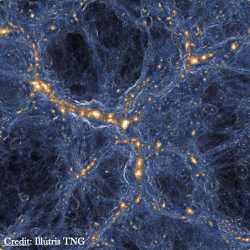 Our Universe on Large Scales. When we look at the night sky, most of the twinkling dots we see are nearby stars within our own galaxy, the Milky Way. At first glance, these stars seem scattered randomly, with some areas densely populated and others nearly empty. Ancient civilisations, like the Greeks, even noticed patterns and named constellations based on them. But there's much more to the cosmos than meets the eye. If we could zoom out, we would discover even more dots—these would be stars from galaxies beyond our own. Zoom out further, and an entire galaxy, with its tens of millions of stars, would shrink to a single dot. And as we continue zooming out, these dots—representing galaxies—begin to form what we call the Large-Scale Structure of the Universe, a vast web of galaxy clusters and empty spaces called voids.
Back in Time. Remarkably, on large scales, the Universe appears to be both homogeneous and isotropic. This means that, no matter where we are or which direction we look, these cosmological structures seem roughly similar. These structures are the result of billions of years of time evolution under the effect of gravity, as tiny initial fluctuations gradually collapsed to form galaxies. But how do we know this? Because light travels at a finite speed, when we observe distant objects in the sky, we are actually looking back in time. The farther away something is, the older the light we are seeing. Using this incredible fact, cosmology aims to piece together the Universe’s history from its earliest moments to the large-scale structures we observe today.
Quantum Origin of Structure. A natural question that arises is: where did these initial fluctuations come from? The most plausible explanation we have today is quite astonishing! Based on detailed analysis of cosmological data, we believe that the early Universe experienced a very brief but intense phase of accelerated expansion, known as inflation. This expansion was so immense that tiny quantum scales were stretched to cosmic scales. According to quantum physics, even empty space isn’t truly empty—it contains tiny, fleeting "wiggles" called quantum fluctuations that constantly appear and vanish almost instantly. During inflation, these quantum fluctuations were amplified into macroscopic density fluctuations, which eventually became the structures we observe today.
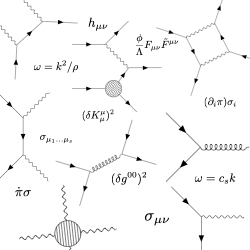 Laboratory for High-Energy Physics. Although there is strong evidence supporting inflation, much about its underlying physics remains a mystery. For instance, we don't know exactly what particles were at work during that time nor how they interacted. There is one main reason for this. Inflation is believed to have occurred at an incredibly high energy scale, far beyond what our most powerful ground-based particle collider experiments can replicate. This means we cannot safely extend our current theories to that early phase of the Universe. But rather than being a limitation, this is actually an exciting opportunity! The early Universe might have left behind clues—through late-time observations—that hint at potential new physics in a completely unexplored high-energy regime.
Observing rather than Experimenting. You might rightly wonder how we can even study the physics of inflation and test our theories. In typical particle collider experiments, fundamental laws of Nature (such as the properties of elementary particles like their masses) are probed by smashing particles together and examining the resulting debris. These high-energy collisions create new particles, which can then be detected and measured. The particles we detect provide insight into what occurred during the collision. However, importantly, fundamental particles are governed by quantum principles, which are probablistic, and we can’t predict outcomes with certainty. The objects we measure are called cross sections, and tell us about how probable a certain process is. It means that we need to perform a lot of collisions to be able to correctly extract the physical properties of elementary particles. This is of course impossible in cosmology, as the history of the Universe only unfolded once. Instead, we use a different approach: we observe in different directions in the sky. By measuring specific signals or objects in different parts of the sky, we collect data as if they were coming from independent experiments. Assuming that the laws of physics are the same everywhere in the Universe, we are able to extract information about the physical processes that shaped the cosmos. In essence, where particle physics relies on averaging over many experiments, cosmology is all about performing statistical analysis over many observations.
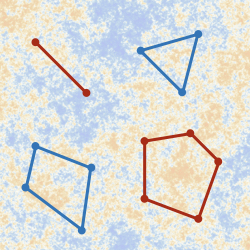 Cosmological Correlators. We cannot predict the exact position of galaxies in the Universe. However, a question we might ask is: what is the probablity of finding a galaxy at a certain distance from another one? By asking this for various distances, we construct something called the two-point correlation function. If all the information about the physics is captured by this function, we say the observed correlations are Gaussian. In other terms, the histogram of observed fluctuations in the sky (the number of fluctuations of a given amplitude as a function of the amplitude) follows a Gaussian curve. However, this function only tells us about the overall amplitude of the fluctuations, not about the specific particles present in the early Universe nor how they interacted. In particle physics, this would be like watching a single particle freely moving without interacting with anything around it, missing out on a lot of interesting information. Instead, we need to look at the correlation between more than two points in the sky. These higher-point correlations deviate from a perfect Gaussian distribution and are known as non-Gaussianities. Remarkably, these cosmological correlators can be theoretically predicted and measured in the sky. This way, cosmological correlators are the key mathematical objects that link theory and observations.
Questions I ask myself. My research is a part of a long-term effort aiming at using these cosmological correlators to understand the physics of the early Universe. Broad questions I ask myself include: How to construct well motivated high-energy theories that describe the early Universe? How to efficiently compute these cosmological correlators? What is the mathematical structure of cosmological correlators? How do they encode new physics? How to precisely measure these signals in the sky? Are there other objects we can measure in the sky that also encode interesting physics?
Main Research Directions
(for aficionados and experts)
Phenomenology of Primordial non-Gaussianities. Concrete, falsifiable signatures of new physics in cosmological correlators (from cosmological collider signals to parity violation), development of numerical tools.
Effective Field Theory Techniques. Effective field theories for primordial fluctuations beyond the single-clock picture, together with the perturbativity, naturalness, and positivity bounds that keep them under theoretical control.
Connecting to Late-Time Cosmological Observables. Testing how primordial signals (features, parity violation, etc) survive late-time non-linear evolution, connecting early-Universe theory to LSS, CMB, and gravitational-wave data via simulations and machine learning.